
Unveiling Manipur's Sexual Violence Crisis
- Kanha Shrivastava
- Aug 12, 2023
- 7 min read
Updated: Jan 21, 2025
Introduction:
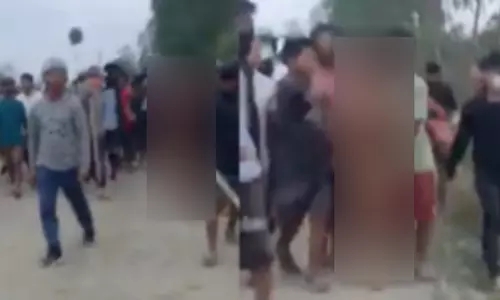
Over the past several months appalling news from Manipur has shocked people across the globe. The ethnic violence has resulted in countless deaths, and displacement of more than 60000 people. vandalism, arson, theft of government armouries, and sexual violence among other crimes. While, the legislature and executive have largely been unable to contain the violence which started on May 3rd, 2023, the viral video which shows two women being paraded around naked on May 4th has truly aghast people resulting in swift actions being taken by the judiciary, which with all of its shortcomings is yet again showing the necessity of its overreaching powers.
Much has already been explained in depth regarding the circumstances and causes which led to the present unrest and this author recommends twolinks to know the same on a factual basis. Thus, this blog critically analyses the current cases pertaining to sexual violence in Manipur and draws a comparative analysis of other such incidents to see possible outcomes.
Cognizance by the Judiciary and NHRC:
As the govt. had been silent on the video, SC in Dinganglung Gangmei v. Mutum Churamani Meitei & Ors. SLP(C) Diary no. 19206/2023 and connected matters on 20.07.23 finally took suo moto cognizance of the video showing two women being paraded naked and subjected to sexual violence. The CJI even orally stated the following:
“The Court is deeply disturbed by the visuals of the video which have appeared in the media since yesterday about the perpetration of sexual assault and violence on women in Manipur. We are of the view that the Court must be apprised of the steps taken by the government to hold the perpetrators accountable and also to ensure that such instances are not repeated in the strife in Manipur. The visuals which are portrayed in the media would indicate reflects gross constitutional violations and infraction of human rights. Using women as instruments to perpetrate violence is simply unacceptable in a constitutional democracy. We direct the Union and the State Government to take immediate steps to apprise the Court of what action has been taken”.
He also stated, “We will give a little time for government to take action otherwise we will step in.”
The National Commission on Human Rights(NHRC) also took cognizance of multiple complaints which sought urgent intervention into the incident of a mob which took away five members of a tribal family from police custody in B Phainom village Kangpokpi district, Manipur on 4 May 2023. The same mob is alleged to have paraded two women naked, brutally gang-raped one of them, and murdered two male members of the family. It also issued notices to the Chief Secretary & the Director General of Police, Manipur for submitting a detailed report within 4 weeks which would include the status of investigations of the FIR, the health status of victims, and compensation, if any, granted.
SCAORA and SCBA also condemned the violence and objected to “illegal” FIRs against Advocates and Activists who were essentially on a fact-finding mission. It is important to be noted that SC has granted protection to an advocate associated with the Communist party against Sedition u/s. 124A of IPC and Attempting to Wage War u/s. 121 of IPC.
Government’s Response and Actions Taken:
In response, the central govt. has entrusted CBI with the investigation and has requested SC to transfer the trial out of Manipur to any other state. The state submitted an affidavit claiming that 7 people have been arrested in the incident, and rehab measures are being taken for the victims including medical treatment, counselling, shelter, security and secrecy, education arrangements, livelihood assistance, and legal aid from DLSA. These actions are consistent with the rights of rape survivors as developed in a no. of cases.
The government has made it mandatory to report all such cases to the DGP; including rewards for reporting such incidents while ensuring anonymity in order to prevent the recurrence of such incidents. The Army (Assam Rifles) and CRPF have also been deployed and 13782 individuals were detained for breaking curfew and other laws by 27.07.23
Petitions before the Supreme Court:
On 28.07.23, the two women approached SC in X and Y v. State of Manipur & Ors., Diary No. 29993-29994/2023, and an urgent hearing was scheduled for 01.08.23. In the hearing, upon submission of the status report by the government, SC noted that over 14 days had passed before the FIR was registered and limited investigation had taken place which suggests that there is an “absolute breakdown of law and order and machinery of the state” as the guidelines given in Lalita Kumari v. State of UP, 2014 (2) SCC 1 have not been followed. The CJI has also remarked that the present case is not similar to the Nirbhaya case as that was an isolated incident.
Though this is a ground for state emergency u/a. 356, the same is unlikely to happen as the state govt. is ruled by BJP.
The petitioners have argued that the two rape victims need not be called again and again to give testimonies due to the trauma they had suffered, to which the CJI orally responded in affirmative if it is in compliance with CrPC. S.164(5A) of CrPC which provides for the recording of witness statements of rape victims and also permits the use of such statements in lieu of examination in chief u/s. 137 of the Indian Evidence Act, on which cross-examination can directly happen. The petitioner’s contention here is in furtherance of the said sub-section.
Various petitions also mention the deliberate omission of not invoking s.376(2)(g) (rape during sectarian violence) and s.376D (gangrape) of IPC, the more specific forms instead of merely invoking s.376 when it is a common practice that both the general and specific forms of a crime are usually invoked to ensure that if the requirements of a specific law like murder u/s. 300 of IPC are not met, the accused would be punished under the general law like culpable homicide u/s. 299 & 304 of IPC. As s. 376D provides for enhanced punishment i.e. a minimum of 20 years extendable to life imprisonment meaning imprisonment for the remainder of that person’s natural life and as s. 376(2)(g) also provides for punishment of minimum 10 years extendable to life imprisonment meaning imprisonment for the remainder of that person’s natural life, instead of merely ‘life imprisonment’ where governments have been known to release convicts upon completion of 14 years like in Bilkis Bano case; there is clear intention and collusion of the police, which necessitate the setting up of SITs, and warrant the transference of cases to other states. Especially since the relevant provisions of the Scheduled Tribes (Prevention of Atrocities) Act, 1989 have also not been applied in the FIRs by the police, which itself may be a violation under s. 4 of the act that applies when such omission is by a police officer, not being a member of a Scheduled Caste or a Scheduled Tribe.
Various other petitions have been filed seeking the formation of an independent Special Investigation Team (SIT) to investigate the violence under the supervision of SC to look at all the cases. One such petition mentioned the gangrape and murder of two other women. It is worthy to be mentioned that the CBI itself set up an SIT for certain cases before it was entrusted with the responsibility of investigating all such cases.
There is precedence for some of the demands of the petitioners after all, such incidences in India have unfortunately been frequent. The SC had directed the setting up of a Special Investigation Team and a special SIT court for the Gulbarg Society Massacre during the 2002 Gujrat Riots. SITs have also been regularly set up to deal with cases that the existing law enforcement agencies are incapable of effectively handling. The ongoing Nuh violence, violence over CAA in Delhi, and tax evasion by keeping black money abroad are just some of the instances where SITs have been set up. Thus, the SC agreed to form a high-powered committee comprised of three former female HC judges to look at relief, restoration of homes and places of worship, and remedial and rehabilitation measures. The question of whether an SIT should be set up as there are over 6500 FIRs which would be difficult for CBI to investigate, was also discussed, and partially agreed upon as SC ultimately entrusted the investigations of the 11 FIRs related to sexual violence to CBI, provisioning that 5 officers of at least DySP rank from other states, will be included in the team investigating them. The court also appointed Mr Dattaray Padsalgikar IPS, former Maharashtra and Mumbai Police Commissioner, to oversee the CBI investigation, while functioning within CBI’s administrative set-up, and reporting back to the court.
With regards to cases not transferred to the CBI, the court noted the constitution of 42 SITs in the state police to investigate and directed that at least one inspector from other State Police forces would be included in every SIT, which will all be supervised by 6 DIG rank offices outside of Manipur.
While, the Best Bakery case, is a precedent for transference of cases to Bombay by SC, as pressures exerted by the accused had resulted in witnesses turning hostile and their acquittal, the same has not yet been done.
Conclusion:
Though the judiciary like the executive and legislature itself was largely silent on the matter, especially since it has been criticized for overreaching its powers, the recent case has forced it to reevaluate its stance and become proactive again as can be seen with delaying the hearings till after the vacations were over. The fact is that after three months of violence, the ineffectiveness of the police in a state which only just got back limited internet access is starting to come to light more quickly and it has become imperative to protect human rights, bring other cases of sexual violence other than the 11 registered FIRs out of more than 6500 FIRs, and to provide swift justice to all the survivors. For the time being, SC has ordered on 07.08.2023 the formation of a high-powered committee of former female HC judges to look after their welfare, entrusted CBI with the investigation of FIRs regarding sexual violence, and formed SITs to investigate the other cases in corroboration with the state police, all of which will comprise of people from outside the state to prevent any collusion.
These actions by the Judiciary have yet again placed it in an oversight executive capacity, at a time when it has been criticised for consistently walking a thin line such as when it recently appointed the CJI in the committee recommending the Chief Election Commissioner. Whether a stronger judiciary is what India needs, is however a topic of another debate. What this case certainly proves is the necessity of the judiciary when the executive and the legislature do not act effectively act to provide remedies to sexual violence survivors.
Kanha Shrivastava, Third Year BBA LLB(Hons.) Student, UPES


Ngày nào mình cũng ngó qua mấy kênh soi cầu XSMB/MB trước giờ quay để bắt nhịp, chứ sát giờ mới xem thì dễ cuống. Mình hay ghép dự đoán XSMB với thống kê lô gan và lô xiên để nhìn ra hướng đi của dàn số, đỡ đoán theo cảm giác. Trong nhóm cũng có người khuyên nên quay thử rồi đối chiếu lại dữ liệu cũ để xem tần suất có hợp lý không, nhất là khi kết hợp thêm vài công cụ kiểu quay thử XSMB hay Rồng Bạch Kim. https://soicauxsmb.pro/ mình chỉ lướt để so sánh thêm thôi, không bao giờ tin mỗi một nguồn. Nói chung dự đoán miền Bắc vẫn phải cân giữa cầu…
Mình mua vé số chủ yếu cho vui thôi, coi như thêm chút hồi hộp mỗi ngày chứ chẳng đặt nặng chuyện đổi đời. Trước đây nghe người ta bàn về đủ kiểu “cầu kèo” mình cũng nghi ngờ lắm, nhưng theo dõi một thời gian thì thỉnh thoảng thấy có vài chỗ trùng lặp khiến mình tò mò. Mỗi lần đọc mấy bài nhận định, mình thường ghi lại vài con số hoặc ý chính rồi để đó, bữa sau mở kết quả ra so lại xem có phải mình tự gán ghép không. Dạo gần đây rảnh rỗi mình có lướt https://soicauxsmb.io/soi-cau-666.html để có thêm chuyện nói với bạn bè. Có hôm trúng chút thì cười cả ngày,…